 Ultimate guide
Advanced Emergency Medical Training for Security Professionals
Quick Summary
Advanced emergency medical training for security professionals means learning to control bleeding, support breathing, and keep injured people stable until EMS arrives. Security staff are often the first trained people on scene, so skills like Stop the Bleed, first aid, and CPR matter most in the first minutes, with EMR or EMT training for supervisors and dedicated medical roles.
- Front-line officers should start with first aid, CPR, AED, and Stop the Bleed.
- Stop the Bleed is the fastest entry point and targets severe bleeding.
- Supervisors and team leads can add Emergency Medical Responder training to direct response.
- An AEMT certificate alone does not authorize interventions; state law and medical direction decide scope.
- Post orders should state what officers are expected to do and when to hand off to EMS.
Table of Contents
- Why Security Professionals Need Advanced Emergency Medical Training
- The Training Levels: From First Aid and CPR to Advanced EMT
- Stop the Bleed Training: The Fastest Entry Point for Security Staff
- Protective Medical Response Training for Armed and Unarmed Roles
- Advanced EMT Certification: Requirements, Pathway and Scope of Practice
- Role-Based Training Pathways for Security Personnel
- Emergency Medical Training Cost: What Drives the Price
- Legal Authority, Liability and Training Currency
- Choosing Your Next Training Step at Tactical Trash Pandas
- Frequently Asked Questions
Why Security Professionals Need Advanced Emergency Medical Training
Last Updated: November 15, 2026
Security work puts people closer to injury than most jobs do.
The core point is simple: advanced emergency medical training for security roles is about controlling bleeding, supporting breathing, and keeping an injured person stable until professional care takes over. A FBI Law Enforcement Bulletin article on training standards for emergency medical response in active-threat situations makes the same argument for police officers, noting that the level of medical instruction provided to officers and the impact of specific training are both worth evaluating.
Paramedic research points in the same direction. An 2024 integrative systematic review on paramedics and patient safety in prehospital care examined how responders contribute to patient safety before a patient reaches a hospital.
Why this matters for security professionals specifically:
- You are often the closest trained person. Staff at a venue, facility, or client site may be the only people within reach when someone is hurt.
- Professional help may be delayed. Response times vary with location, traffic, and the scale of an incident, so the first few minutes can rest entirely on the people already present.
- Liability follows the response. Documented, trained action is easier to defend than improvised action, a point covered later in this guide.
Stop the Bleed, first aid, and CPR are common entry points for security teams. The sections below walk through each training level, from basic bleeding control through Advanced EMT, and explain how each fits a security role.
The Training Levels: From First Aid and CPR to Advanced EMT
Emergency medical training runs on a ladder. Each rung adds scope, time, and cost, and each has different uses for a security professional. Most people do not need the top rung. Most people do need the bottom two, and many benefit from the middle one.
The main levels a security professional will encounter are:
- First aid, CPR, and AED for everyday response to cuts, burns, fainting, and cardiac arrest
- Emergency Medical Responder (EMR) for trained first response, usually a short course
- Emergency Medical Technician (EMT) for patient assessment and care at the basic life support level
- Advanced EMT (AEMT) and paramedic for advanced skills, with longer pathways and more demanding prerequisites
Each step up is a different commitment. Confirm requirements with the certifying body before enrolling, since prerequisites and recertification rules change.
First Aid, CPR and AED Basics
First aid, CPR, and AED training is the foundation that most security roles should have before anything else. It covers the situations a guard is most likely to face: bleeding, choking, unresponsiveness, and sudden cardiac arrest.
This level takes the least time and carries the lowest cost, and it is the easiest to justify to an employer or a client.
Emergency Medical Responder and EMT Training
The EMR and EMT levels add patient assessment, airway management, and structured care protocols. They are more involved than first aid and typically require classroom and practical components, along with a certification exam.
For most security staff, EMR is the practical ceiling. Find the Emergency Medical Responder and EMT training options available locally. EMT is a reasonable goal for supervisors, dedicated medical-response officers, or anyone planning to move into EMS.
Stop the Bleed Training: The Fastest Entry Point for Security Staff
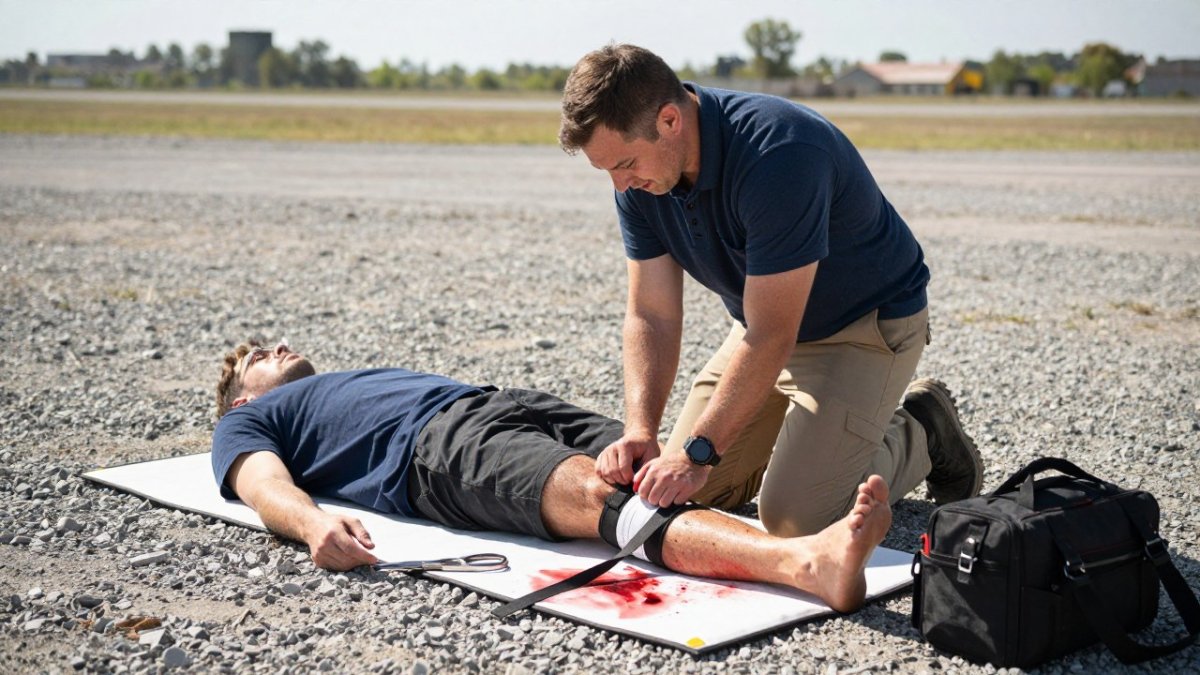
Stop the Bleed is the fastest way for a security team to build useful emergency skills. See the local Stop the Bleed, First Aid, and CPR course listing.
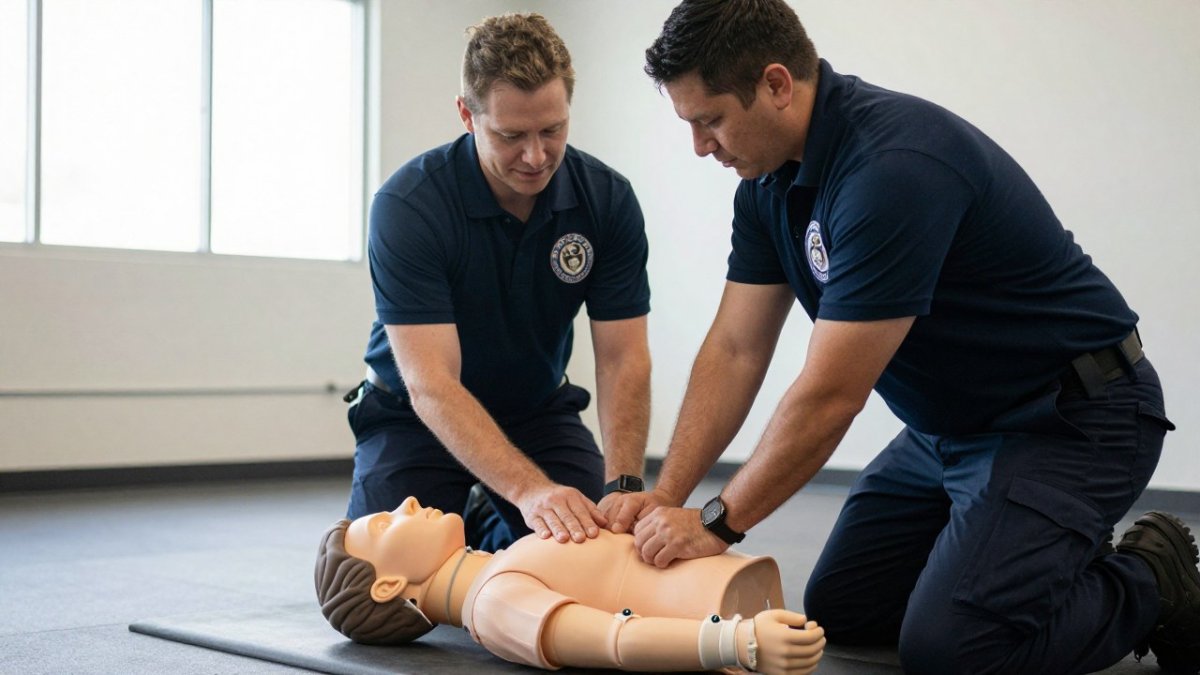
For a security team, the value is in the skills being taught, not the course title.
Two security officers practicing hands-on bleeding control with a tourniquet on a training manikin in a classroom
Practical steps for building this into a security program:
- Start every new officer with Stop the Bleed in their first month.
- Keep tourniquets in the same place at every post, and check them on a fixed schedule.
- Run short hands-on drills so the skill stays fresh between courses.
Stop the Bleed also works as a bridge.
The table below summarises the main training levels and what each one covers, drawn from the article.
| Level | Best for | Key difference |
|---|---|---|
| First aid, CPR and AED | Everyday response for all staff | Lowest time and cost; covers bleeding, choking, cardiac arrest |
| Stop the Bleed | Front-line officers, first month | Fastest entry point; targets severe bleeding |
| Emergency Medical Responder (EMR) | Post supervisors and team leads | Trained first response; usually a short course |
| Emergency Medical Technician (EMT) | Dedicated medical-response roles | Patient assessment and basic life support care |
| Advanced EMT (AEMT) | Narrow cases such as licensed on-site contracts | Adds state-defined advanced skills under medical direction |
| Paramedic | Individuals pursuing a longer EMS career | Highest level; longest pathway and most demanding prerequisites |
Protective Medical Response Training for Armed and Unarmed Roles
Protective medical response training addresses a specific problem: how to deliver medical care while a threat is still present or uncertain.
This training is relevant to both armed and unarmed roles, but the emphasis differs.
Protective medical training is also used by executive protection teams, event security, and facility staff in higher-risk environments. Browse tactical emergency medical courses offered in Manassas, VA.
Advanced EMT Certification: Requirements, Pathway and Scope of Practice
Advanced EMT (AEMT) sits between EMT and paramedic on the credential ladder. It is not a security certification and it is not a substitute for tactical medicine training. It is a clinical credential that expands what a provider may legally do under medical direction, and that distinction matters more for security teams than the letters after a name.
What AEMT actually adds over EMT
An EMT works at the basic life support level: patient assessment, airway positioning, oxygen, CPR and AED, bleeding control, splinting, and assisting with some patient-administered medications. An AEMT adds a defined set of advanced skills, which in most states includes IV and IO access, advanced airway adjuncts, and administration of a limited list of medications under protocol.
That is the mechanism security leaders need to understand: the certificate is a prerequisite, and the scope is granted by the state and the medical director. A course completion card alone authorizes nothing.
Prerequisites and pathway
A common pattern for AEMT entry is:
- A current EMT certification in the state where you will practice
- A minimum age (often 18) and a high school diploma or equivalent
- Current CPR for the professional rescuer, typically AHA Basic Life Support
Program length is typically several months of classroom, skills lab, and clinical or field time, substantially more than an EMR course and materially less than paramedic. Most programs end with a psychomotor skills exam and a written exam, and credentialing runs through the state EMS office or the National Registry of Emergency Medical Technicians, depending on the state.
Scope of practice is state law, not course content
The scope of practice for an AEMT is defined in state EMS regulations and implemented through local medical direction. That means the same credential carries different authority across state lines, and a security officer who moves to a new state should not assume the old scope travels. Confirm three things before relying on an AEMT credential on a security post:
- Whether the state recognizes the credential for the setting you work in
- Whether your employer or client site has a medical director who has authorized the skills in writing
- Whether your agency's protocols, standing orders, or post orders actually permit the intervention
Watch out: assuming an AEMT card authorizes IV access or medication administration on a private security post is a common and costly error, because private-site authority usually runs through employer policy and a medical director, not the certificate alone.
Does a security team need AEMT?
For most security programs, no. The realistic ceiling for a front-line officer is first aid, CPR, AED, and Stop the Bleed; the realistic ceiling for a supervisor or dedicated medical-response officer is EMR or EMT. AEMT becomes relevant in a narrow set of cases: a contract that requires a licensed EMS-level provider on site, a large venue with a dedicated medical team, or an individual building toward paramedic. That distinction makes prehospital training for security forces most useful when it prepares officers to deliver care under threat while staying within their role.
Role-Based Training Pathways for Security Personnel
The most useful way to plan training is by role, not by certification name. A single certificate does not cover every job, and over-training a guard who only needs bleeding control wastes time and money.
A practical role-based approach:
- Front-line officers: First aid, CPR, AED, and Stop the Bleed. These are the skills most likely to be used.
- Post supervisors and team leads: Add EMR, so they can direct response and make triage calls.
- Dedicated medical or protective-response roles: Add EMT or protective medical response training, matched to the duties in the job description.
Map each role to the tasks it performs on a normal shift, then choose the training that closes the gap. Revisit the map whenever duties change.
Emergency Medical Training Cost: What Drives the Price
Emergency medical training cost varies widely, and the honest answer is that the price depends on the level, the format, the length, and the provider. Pricing depends on quantity, class dates, and delivery format.
Several factors shape what you will pay:
- Course level. A short Stop the Bleed session costs far less than an EMT or AEMT pathway.
- Format. Private or group classes, on-site delivery, and hybrid formats price differently.
- Group size. Training a team at once is usually more efficient per person than individual enrollment.
When comparing providers, look past the headline number. Compare what is included, how many hours of hands-on practice you get, and whether the credential you receive is recognized for the role you need.
Legal Authority, Liability and Training Currency
Most training pages stop at the certificate. For the broader case for medical training in personal and professional safety, read why medical training belongs in every personal safety plan. The part that actually protects a security professional is the legal framework around the response, and that framework is built from four separate mechanisms that are easy to confuse.
1. Scope of practice is set by the state
Scope of practice for EMS credentials is defined in state law and regulation, usually through the state EMS office. It describes what an EMR, EMT, AEMT, or paramedic may do. It does not describe what a security officer may do on a private post. Those are different questions, and conflating them is the most common legal mistake in security medical programs.
2. Medical direction authorizes the intervention
Even a credentialed provider generally acts under the medical direction of a physician or an EMS agency's protocols. On a private security site, that authority usually has to be created deliberately: a written medical director agreement, standing orders, or employer policy that names the permitted interventions. Without that, a certificate is evidence of training, not permission.
3. Good Samaritan laws vary by state and have conditions
Most states have some form of Good Samaritan protection for people who render emergency care in good faith, but the conditions differ. Common conditions include acting without expectation of compensation, acting within your training, and not acting with gross negligence or willful misconduct. A paid security officer responding on duty may fall outside some protections that cover a bystander, which is why employer policy and documented training matter more in a paid role than in a volunteer one.
4. Duty to act can be created by the job
A security officer may have a duty to act that a bystander does not, depending on the employment relationship, post orders, and state law. Once a duty exists, failing to render aid within your training can create liability that a bystander would never face. The practical implication is that post orders should state clearly what officers are expected to do, what they are not trained to do, and when to hand off to EMS.
What this means for a security program
- Write the authority down. Name the medical director or the policy that authorizes each intervention, and keep it current.
- Train to the policy, not past it. If the post orders do not authorize a skill, do not teach it as an operational expectation.
- Document every response. Time of injury, assessment findings, interventions performed, and time of EMS handoff. A clear record protects the responder and the patient.
Watch out: treating a course completion card as universal authorization is the single most common liability trap in security medical training, because the card proves training while the state, the medical director, and the employer policy decide what you may actually do.
Confirm the specifics with your employer, legal counsel, or the state EMS office before relying on any credential in an operational setting.
Choosing Your Next Training Step at Tactical Trash Pandas
Start with your role, then choose the next step. For most readers, that means first aid, CPR, and AED, followed by Stop the Bleed.
Tactical Trash Pandas provides reality-based safety and firearms training, including emergency medical procedures and First Aid and CPR.
If you are weighing tactical casualty care for a security role, compare available protective medical training against your daily duties.
Choose one step, schedule it, and build from there.
Frequently Asked Questions
How hard is it to get an Advanced EMT certification?
An Advanced EMT (AEMT) certification builds on the EMT level and requires completing an approved AEMT program with both classroom instruction and supervised clinical hours, followed by passing the National Registry of Emergency Medical Technicians (NREMT) cognitive and psychomotor exams. The EMT certification is a prerequisite, so the total path is longer than most first-aid courses. Security professionals who already hold an EMT credential usually find the step manageable. Those starting from first aid should plan for several months of study and practice, and should confirm current prerequisites and state licensing requirements before enrolling.
What medical training is required for security guards?
In most US states, basic security guard licensing does not mandate medical certification, so the requirement comes from employers and the nature of the post. Common baseline training includes first aid, CPR and AED use, and Stop the Bleed. Roles with higher risk, such as armed or executive protection positions, often add Emergency Medical Responder or protective medical response training. Requirements vary by state and employer, so check your state's security licensing board and your employer's policies.
What is the difference between Stop the Bleed training and EMT training?
Stop the Bleed training teaches a narrow set of skills: recognizing life-threatening external bleeding, applying direct pressure, packing wounds and applying tourniquets. It is short and designed for bystanders and non-medical staff. EMT training covers patient assessment, airway management, medication administration under protocols and a broad range of emergency conditions, and it requires a formal program, clinical hours and national certification. Stop the Bleed is a useful first step, while EMT provides clinical scope well beyond bleeding control.
Can security professionals take advanced emergency medical training online?
Parts of emergency medical training can be completed online, usually the didactic or classroom components. Hands-on skills such as CPR, tourniquet application, airway management and patient assessment must be practiced and evaluated in person with an instructor. Many EMT and AEMT programs use hybrid formats. Security professionals should confirm which portions are online, whether the program is accredited, and how practical skills are verified before enrolling.
How much does emergency medical training for security professionals cost?
Costs depend on the course level, program length, class format, materials and whether certification exam fees are included. Short courses such as CPR or Stop the Bleed are generally less expensive than full EMT or AEMT programs, which involve many more hours. Pricing depends on quantity, dates, and delivery. For current prices and any group or instructor-led options, check the Tactical Trash Pandas website or request a quote directly.
What types of emergency medical training should security professionals consider?
Security professionals should match training to their role. Most benefit from a foundation in first aid, CPR and AED use, and Stop the Bleed. Those in higher-risk or armed roles may add protective medical response training, and those seeking clinical responsibility may pursue EMR, EMT or Advanced EMT certification. Consider your duty environment, likelihood of medical incidents, and employer expectations when deciding how far to advance.
How long does it take to go from EMT to AEMT?
The time depends on the program format and whether you study part time or full time. AEMT programs add substantial coursework and clinical hours beyond the EMT level, and many students take several months to a year to complete them. After finishing the program, candidates must pass the NREMT AEMT exam and meet state licensing requirements. Confirm program length and recertification rules with your state EMS office before committing.