 How-to
What Should You Ask a Gun Instructor Before Class?
Last Updated: November 3, 2026
Quick Summary
Ask any gun instructor about certifications, years teaching, safety enforcement, class structure, range emergency plans, costs, and private instruction. Confirm what the fee covers and get the cancellation policy in writing, and ask how lessons are planned and progress tracked.
- Introductory safety classes often run a few hours, while permit courses typically take a full day.
- Showing up with a loaded firearm when the class requires it unloaded and cased can get you removed from the range.
- Range safety procedures should be explained before anyone touches a firearm.
- Tell the instructor your intended use up front, since home defense, self-defense, and sport shooting call for different guns and drills.
- A strong program covers safe handling, first aid, and CPR alongside shooting.
Table of Contents
- Questions to Ask Before a Firearms Class
- Firearms Instructor Qualifications and Teaching Approach
- What to Bring to a Gun Safety Class and How Long Training Lasts
- Intended Use, Concealed Carry, and Firearm Selection
- Range Safety Procedures and Emergency Readiness
- Costs, Equipment, and Cancellation Policies
- Personalized Lesson Planning and Measurable Progress
- Accessibility and Student Comfort
- Ongoing Training and Additional Resources
- Frequently Asked Questions
Questions to Ask Before a Firearms Class
Choosing a gun instructor is the most important safety decision a new shooter makes. Here are the exact questions to ask before a firearms class.
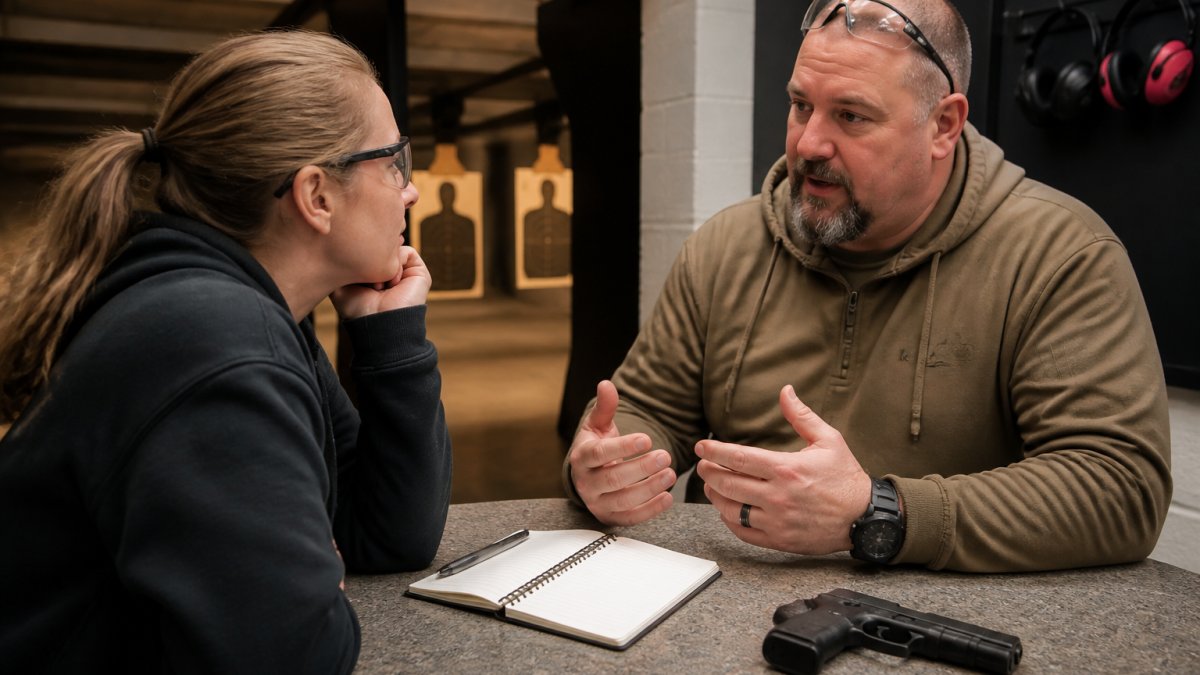
Ask any gun instructor about certifications, years teaching, safety enforcement, class structure, range emergency plans, costs, and private instruction.
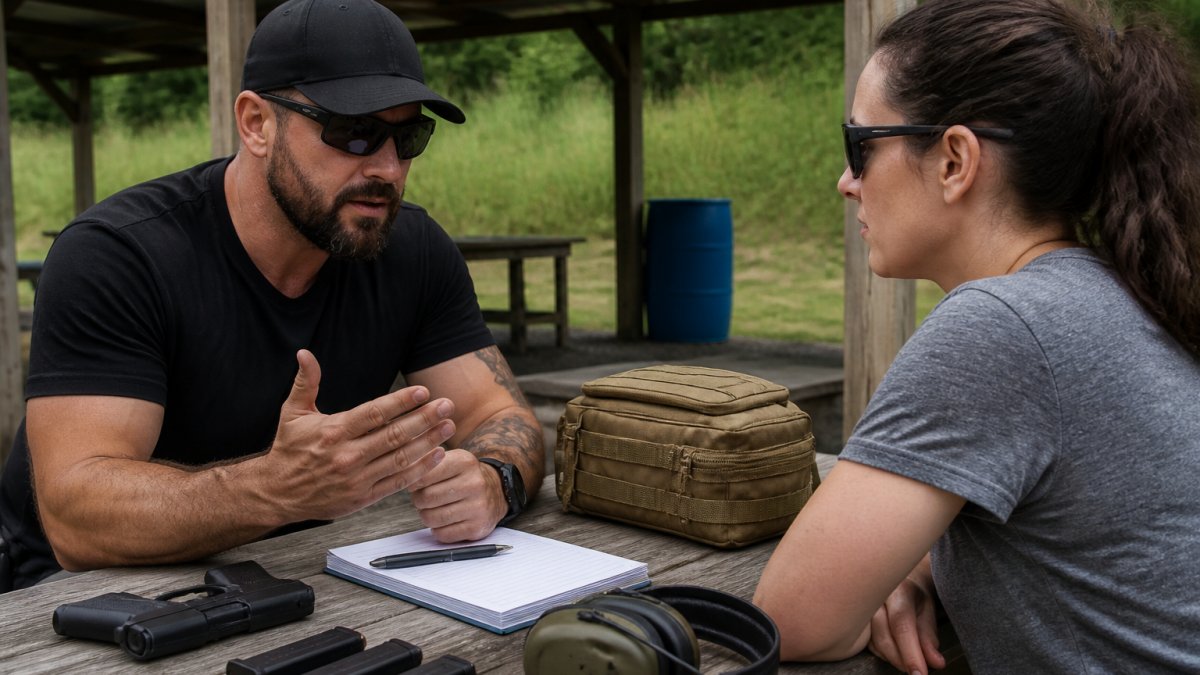
To assess an instructor's style directly, one-on-one pistol training lets you see how they teach before committing.
Firearms Instructor Qualifications and Teaching Approach
Firearms instructor qualifications should be specific and verifiable: certifying bodies, certification dates, and current liability insurance.
A good instructor explains why a technique works, checks eye dominance early, and discusses recoil tolerance and firearm fit before handing over a gun.
- They ask about your goals before talking about their own credentials
- They explain shooting fundamentals in plain language
- They build in time for student questions
The RAND Corporation has analyzed how firearm safety training requirements affect outcomes, and the takeaway for students is simple: the quality of instruction matters as much as the requirement itself. See RAND's research on firearm safety training requirements for the full analysis.
To evaluate qualifications and teaching style firsthand, one-on-one firearms training is the clearest test.
What to Bring to a Gun Safety Class and How Long Training Lasts
Introductory safety classes often run a few hours, permit courses typically take a full day, and defensive and advanced courses stretch across multiple sessions.
Confirm whether the instructor provides loaner firearms and ammunition, and ask about equipment review.
For practical tips, read 5 tips for safe and effective firearms training. If you are still deciding whether to train before you buy, should you take a firearms class before you buy your first handgun answers that directly.
Watch out: showing up with a loaded firearm when the class requires it unloaded and cased is a common first-day mistake that can get you removed from the range.
Here is what to expect for class length and what to bring, based on the article.
| Item | Value | Note |
|---|---|---|
| Introductory safety classes | A few hours | Typical length |
| Permit courses | A full day | Typical length |
| Defensive and advanced courses | Multiple sessions | Stretch across sessions |
| Bring: ID and paperwork | Photo ID and permit paperwork | Required items |
| Bring: protection | Eye and ear protection | Required items |
| Bring: clothing | Sturdy belt and closed-toe shoes | Required items |
| Bring: extras | Water and a snack | Required items |
| Bring: firearm | Firearm and ammunition if required | Confirm loaner gear with instructor |
Intended Use, Concealed Carry, and Firearm Selection
Tell the instructor your intended use up front. Home defense, self-defense, and sport shooting call for different guns and different drills.
Ask how the instructor handles legal requirements and local laws, and whether they point students to official state resources. For carry rules, the U.S. Concealed Carry Association state law guides are a useful starting reference.
Range Safety Procedures and Emergency Readiness
Range safety procedures should be explained before anyone touches a firearm. Ask the instructor to walk you through range commands, the emergency plan, and medical emergency handling.
A strong program covers safe handling, first aid, and CPR alongside shooting. Ask directly: what happens if someone is injured on the range?
Costs, Equipment, and Cancellation Policies
Ask for the full cost breakdown before you commit. Confirm what the fee covers, instruction time, range fees, ammunition, targets, and materials, and get the cancellation and rescheduling policy in writing.
Personalized Lesson Planning and Measurable Progress
Ask how the instructor plans lessons and tracks progress. Good programs set training goals at the start and check them at the end.
Ask whether students can state and apply the core safety rules, load, unload, and clear the firearm safely, and demonstrate shooting fundamentals on target.
Accessibility and Student Comfort
Ask whether the class suits complete beginners, and how the instructor handles nervous students. A supportive, judgment-free setting helps new shooters build confidence and mental readiness.
Ask about class size, physical demands, and accommodations for limited mobility or hearing protection needs.
Ongoing Training and Additional Resources
Ask what comes after the first class: practice plans, additional resources like websites, books, and videos, follow-up courses, and responsible storage at home.
For students who want their own questions answered directly, submit your questions through our question form.
Frequently Asked Questions
What makes a good gun instructor?
A good gun instructor combines verified credentials with clear communication and patience for beginners. Look for certifications, a teaching approach that explains the why behind each safety rule, and experience with students at your skill level. Ask how they handle a nervous first-timer and whether they build in measurable progress. Tactical Trash Pandas provides reality-based safety and firearms training.
How can I tell whether a firearms instructor is qualified?
Ask directly about certifications, years of teaching, and the courses they have completed. Request proof, such as certificate copies or a training resume. A qualified instructor will answer without hesitation and can describe their own continuing education. Also ask about their insurance and range affiliations. If an instructor dodges the question or cannot name a certifying body, look elsewhere before you book a firearms training class.
Should I bring my own firearm to a beginner class?
Many beginner classes provide loaner firearms, so ask before you buy anything. If you plan to bring your own, confirm the range allows it and that your firearm fits your hand and recoil tolerance. Ask what ammunition the class requires and whether rentals are included. For a first lesson, using the instructor's equipment often makes more sense, and you can decide on firearm selection afterward with guidance.
Choosing an instructor is a decision about safety, not scheduling. If you want instruction that covers defensive firearms, emergency medical procedures, and risk mitigation in one place, Tactical Trash Pandas builds courses around practical tactics and real-world readiness, with training for every skill level from first-time shooters to seasoned pros. Get started with Tactical Trash Pandas and train with a clear margin of safety.